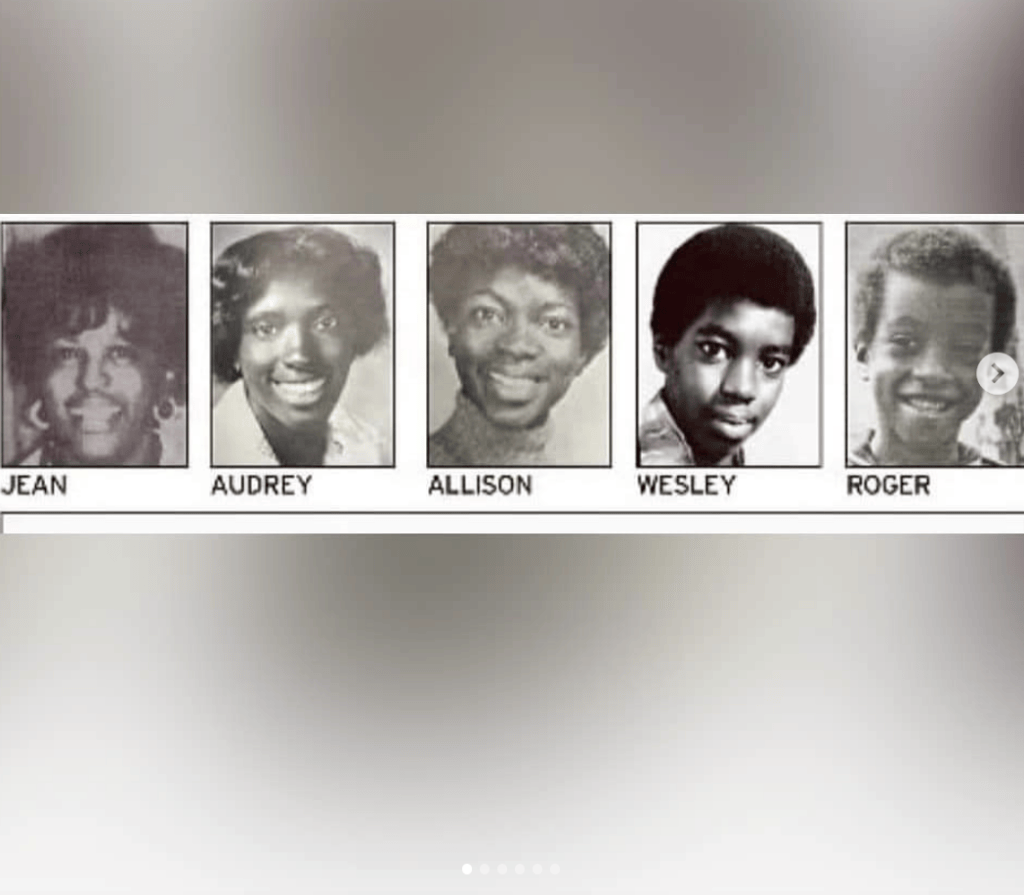
At approximately 4:00 p.m. on a cold Saturday on December 6th, 1975, Wesley Diggs arrived at his newly purchased large Suburban, New Jersey home. He walked through his front door as if it was any other day expecting to greet his wife and children. But when he walked in, he immediately knew that something was wrong; the house was completely quiet. Upon searching, Wesley discovered his 17-year-old daughter Audrey lying in a pool of blood on the floor of her bedroom. She had been shot five times in the head with what appeared to be a .22 caliber automatic pistol.
After finding the phone lines dead, Wesley ran next door to his neighbor’s house, who was a nurse yelling at them to call an ambulance because Audrey was hurt.
The neighbors, a mother and her daughter, returned to the house with Wesley. The mother went downstairs and discovered Jean in the basement, dead from gunshot wounds to the chest and head. The daughter went upstairs, then quickly came back down to tell Wesley that his daughter Audrey was dead.
Police were called, and while Wesley was kept downstairs, they checked the house and discovered 12-year-old Wesley Jr. and 5-year-old Roger, still in their pajamas in the room they shared, and 16-year-old Allison shot twice in her head in her attic bedroom, the television still on. All of the children were shot execution style.
And Wesley’s 39-year-old wife Jean was found in the basement recreation room, having been shot once in the head and once in the chest.
Wesley was distraught at the scene and had to be restrained. Inside the house, investigators found 23 shell casings, all .22 caliber. All but three of the casings were near the bodies.
Wesley did not know his entire family had been slain when he was taken to Teaneck police headquarters for questioning. Cops wanted to know his whereabouts, and he told investigators he’d spent Friday night with his girlfriend in Harlem after attending a political fundraiser for a New York state assembly man at one of his bars.
Wesley told cops that although his wife didn’t approve of his infidelity, she tolerated it. The friction in the marriage and the nature of the crime initially made him the prime suspect.
“Wes, on the spot, had to decide: Am I going to create a false narrative or tell the truth?” “To his credit, he decided to tell the truth.”
Although he was the prime suspect, he passed two lie detector tests after the killings and was cleared by the Bergen County Prosecutor’s Office. The media assumption, as well as the assumption of many of his friends, was that he had to be part of it,” said Bob Chase, a retired minister who was pastor of the Presbyterian Church of Teaneck, where the funeral for the Diggs family drew over 1,000 people. Wesley wanted to keep the funeral “low-key,” which was impossible given the publicity of the case.
Wesley didn’t speak at the funeral but instead had a friend read a letter he wrote to his wife and family that spoke of the survivor’s guilt that would follow him all the days of his life.
“I consider myself your protector, your shelter in the time of storm,” he wrote to his family. “Now I ask you to forgive me for not sheltering you in your greatest hour of need.”
Robbery did not appear to be the motive for the murders. The home had not been ransacked, and there was no sign of forced entry. It also appeared that the family members might have known who the shooter or shooters were, as none of the victims evidenced any hint that they had struggled, and all had been shot where they sat.
Bob Chase, who was 27 years old at the time and five days into his tenure as pastor when the Diggs family was murdered, so believed in Wesley’s innocence that he wrote a book about it. The book “Diggs” didn’t sell much and is long out of print, but the mystery of who did it and why lives on.
“I was convinced he didn’t do it, and I wrote the book to clear his name,” said Bob, who is now 77 and lives in Palisades, New York.
“Wes was one of the kindest, most generous people I ever met. He was generous with his time, and generous to people in the community in Harlem. He worked hard to find the killer; he even hired a private detective and a psychic.”
Still, suspicions swirled around Wesley, an entrepreneur who owned four bars with his brother, plus a card store and two apartment buildings in Harlem. Many wondered if he was somehow involved through his bar business.
Wesley’s personal finances also came under scrutiny. An article published in The Record days after the murder revealed that he owed more than $100,000 to a loan company and was struggling to keep his bar businesses afloat.
Bars, particularly those in Black neighborhoods, often had trouble obtaining credit from banks, which forced them to find other lenders.
The Record reported that in an unusual arrangement, Wesley was paying back his loan in weekly installments, and not monthly, which is the norm with banks.
Wesley Diggs also petitioned then-president Gerald Ford to bring the FBI in on the investigation.
Former Teaneck mayor Paul Ostrow who was 25 years old that day and a volunteer on the ambulance squad recalled responding to an initial call of “multiple injuries” at a house on Carlton Terrace.
But when he got there, the police tape had already gone up and the emergency was over.
He said by the time he got there, the house was being cordoned off, and the police were waiting for the prosecutor to come. It was obvious that everyone in the house was dead and he was glad he didn’t have to go inside.
But if Wesley Diggs wasn’t the killer, then who was? The Bergen County Prosecutor’s Office estimated the shootings took place between 11 p.m. and 2 a.m., but there was no sign of forced entry or robbery.
Investigators on both sides of the Hudson River turned their focus on activities at the four bars that Wesley owned with his brother. Wesley denied any involvement in the illegal drug trade, but cops kept looking for revenge or robbery motive.
Six months after the murders, New York Police Department Detective Lt. James Vitti thought he’d cracked the case. Based on information he obtained from a paid informant, Vitti claimed that three people – the informant, another man and a woman – went to Teaneck to rob the house and shot the family in the process.
However, the informant disappeared soon after the NYPD paid him to wear a wire. And the other man he pointed to was already in prison for murder and the woman had just been paroled.
Detective Vitti went public with his claim in October 1976, but Bergen County Prosecutor Joseph C. Woodcock wasn’t buying it.
They said they knew the people he was talking about but there wasn’t anything there.
The tavern Wesley owned, though, might have had some link with the execution-style murders, and investigators investigated several possible leads and related crimes along those lines. Detectives theorized that the Diggs family massacre could have been connected to another homicide which occurred on December 10th: that of known heroin dealer Stanley Morgan. Morgan had been gunned down by two assailants wielding .22 caliber weapons at New York’s Shalimar Lounge, a bar only a mile from Diggs Den.
Also, an eighteen-year-old burglary suspect named Darryl Scullark had been shot dead at the Apollo Theater in Harlem on December 5th, and it came to light that Scullark had been kicked out of Diggs Den only a short time before, after participating in an altercation on the premises.
Wesley Diggs said he never went back to the house after his family was murdered. He said cops ripped out the radiators and wall fixtures looking for drugs but didn’t find any.
He sold the house in August 1976 and moved back to New York City, where he opened a card shop and sold his bar businesses to his brother. From there, he tried to keep pressure on the police to keep looking for the killer and complained bitterly about being treated as a suspect.
He suggested investigators were blinded by racism, convinced that he had to be involved somehow.
“They were looking for narcotics, not the person who murdered my family,” he said. “I guess a Black guy in Bergen County is not supposed to own a $50,000 house and be a bar owner.”
Of his debts, Diggs wondered, “why can’t a Black man have $138,000 in credit when a white businessman can have a $2 million credit line?”
But it was Wesley’s infidelity that led one Teaneck detective, Fred Greene, to chase the most bizarre theory in the case — that it was Jean Diggs, distraught over her husband’s extra-marital affairs, who killed her children.
As the theory goes, Jean methodically went from room to room killing her children, and when she was finished, she turned the gun on herself. Only she didn’t die, according to the theory, and someone else – not Wesley – shot her and then escaped with the gun.
Wesley struggled daily to find new leads to track down his family’s killer. Detectives work he claimed law enforcement authorities in Bergen County should have been doing.
When Wesley suddenly died on a public street from a heart attack in 1987, police were no closer to solving what had been a disturbing, and very senseless crime. He lived in the shadow of suspicion and whispers.
A former Teaneck resident, Jackie Kates, believes the Diggs family is worth remembering. Jackie met Jean Diggs only once, at a birthday party for her nephew.
Weeks later, her husband was at a dinner in New York, and she was home alone with her two children on a Saturday night when she turned on the 11 o’clock news and saw the headline flash across the screen, “family murdered,” accompanied by a graphic showing a map of Teaneck.
She said she quickly locked all the doors and couldn’t wait for her husband to get home. Soon after, she learned Jean, the pleasant woman she’d met at the birthday party with her cute little son Roger, was dead, along with the rest of the Diggs children.
“The most shocking thing is that something like that could happen, a woman and all her children murdered,” she said. “The second most shocking thing is that it’s never been resolved.”
Jackie said the shock of meeting someone at a birthday party and then learning they’ve been murdered has never worn off.
“No one has ever been brought to justice, and I think it’s worth remembering these five people who lost their lives,” she said.
Today, there are more than a dozen “new” technologies that were only a dream in 1975 but are now commonly used by police departments all over the world. Whether it’s DNA sequencing, 3D scanners, microscopy, ballistics photography, or chemical analysis, any one, or combination of these technologies are now in use and can be accessed in the investigation of any unsolved crime, including ones that are over 40 years old.
There was a based on a True Crime film made, The American Wisper.
Audrey Diggs was a star athlete at Teaneck High School, where she played basketball, softball and volleyball. The Teaneck Board of Education established the Audrey Diggs Memorial Award, given each year to the student-athlete who displays leadership and dedication.
At Teaneck High School, there is also a plaque dedicated to the Diggs family. “Love is eternal,” is the inscription.
The investigation remains “active,” and anyone with information can call investigators at 201-226-5532.
NJ.com True New Jersey, Crime Immemorial, BlackNews.com


Leave a Reply