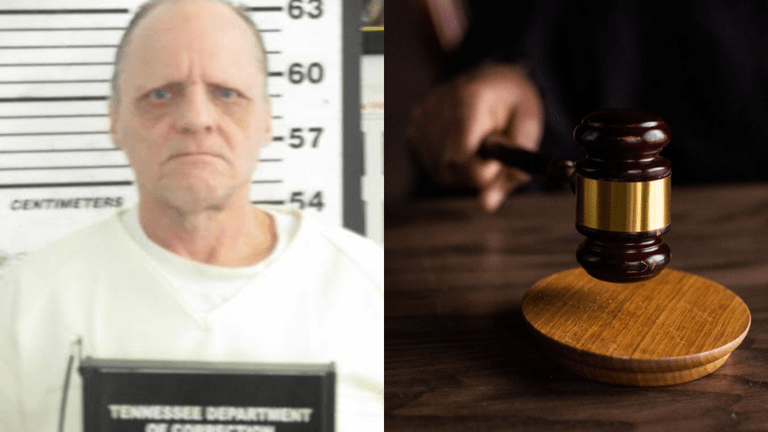
Anthony Darrell Hines was born on April 20, 1960. In early 1985, at the age of 24, he traveled by bus from Raleigh, North Carolina, departing on March 1 with a non-refundable ticket to Bowling Green, Kentucky and twenty dollars in spending money. A witness who saw him before he left recalled that he was carrying a hunting knife in a sheath concealed beneath his shirt. The bus route took him through the Nashville, Tennessee area, and rather than continuing directly on to Kentucky, Hines stopped along Interstate 40 near Kingston Springs and checked into a room at the CeBon Motel.
54-year-old motel maid Katherine Jean “Kathy” Jenkins worked at the Ce’Bon Motel in Kingston Springs, Tennessee. on March 3, 1985,the manager had left her in charge of the motel that morning at about 9:30 a.m., with a Cheatham County State Bank bag containing $100 in small bills to make change for customers. At that point, guests were still occupying Rooms 9, 21, and 24. At some point that morning, Jenkins wheeled her cleaning cart to Room 21. AND Sometime between 1:00 and 1:30 p.m., a visitor to the motel obtained a key from the office and opened the door to Room 21, where he found Jenkins’s body, wrapped in a sheet, partially undressed, with her underwear torn, a $20 bill tucked under her watchband, and multiple stab wounds to her chest and abdomen. The autopsy revealed four deep stab wounds to the chest (2.5–6.4 inches) with a butcher- or hunting-type knife, plus superficial cuts to the neck and collarbone, and a penetrating wound through the upper vagina into the abdominal cavity. The small amount of blood in the vaginal area suggested the injury occurred at or near her death. She also had defensive wounds on her hands and arms. And the autopsy also found evidence of sexual assault. Her Volvo, wallet, and keys were missing, and the bank bag was found in the room, bloody and empty. Investigators later found knife marks on the wall of Room 9, the room where Anthony Darrell Dugard Hines had checked in, which he later admitted were made by a knife.
Investigators later found marks on the wall of Room 9 — the room Hines had checked into that appeared to have been made by a knife being stabbed repeatedly into the wall; when shown photographs of the marks, Hines acknowledged they were knife marks, though ballistics-style comparison indicated they had been made by a different, smaller knife than others associated with him. Jenkins’s wallet was later found wrapped inside a thermal underwear shirt not far from where her car was discovered abandoned. A key to Room 9 of the CeBon Motel was recovered at a site near Cave City, Kentucky, where Hines had reportedly been camping.
Travelers who encountered Hines on the road near Jenkins’s broken-down car recalled that he had dried blood on his shirt, seemed nervous, contradicted himself, and talked at length, at one point claiming he had bought the car from an elderly woman for three or four hundred dollars. When Hines later arrived at a family member’s home, his sister noticed the blood on his shirt, and Hines admitted to her that he had stabbed someone at the motel — though he described the victim to her as a male motel employee who had allegedly assaulted him, and he physically demonstrated the stabbing motion. Around the same time, despite having been unable to afford a bus ticket days earlier, Hines purchased a barbecue grill and told his sister he had come into a substantial amount of money.
When law enforcement took Hines into custody, he volunteered, without having been told a woman had been killed, that he had taken “the woman’s” car but had not killed her. When a Tennessee Bureau of Investigation agent later pressed him to tell the truth about Jenkins’s death, Hines said that if the officer could guarantee him the death penalty, he would confess and tell him everything.
Nearly four decades later, the daughter of Katherine Jenkins says she is still waiting for justice. She said, “This man is going to live rent-free in my head for the rest of my life.” “There’s no closure. It’s not going to bring my mom back.”
Court filings from Hines’ attorneys describe him as suffering from multiple serious medical conditions. His attorneys argued those conditions make carrying out the execution unconstitutional. Melissa Jenkins said those arguments do not erase what her family has lived with since March 3, 1985.
“The criminal gets all of the focus because they are the ones still alive walking around,” she said. “Everybody forgets about the victim and the victims’ families.”
For Melissa Jenkins, the case has already lasted longer than she ever imagined.
“I understand getting a couple of appeals,” Melissa Jenkins said. “But 40 years later, that is just insane.”
Hines was initially sentenced to death in 1986. However, at the time, the court found errors in the jury instructions during the sentencing phase. This led to a new sentencing hearing. In 1989, a new jury again sentenced Hines to death after finding “aggravating factors” that pointed to his crimes. Following the 1989 sentence, Hines filed numerous direct appeals, petitions and claims alleging constitutional violations, ineffective assistance of counsel, and prosecutorial errors.
These proceedings took more than 10 years to resolve. In 2020, a court ruled that Hines “deserved” a new trial since his attorneys had provided ineffective assistance. However, in 2021, the court reversed its decision and upheld the death sentence and the original conviction, after claiming that the evidence of guilt was “overwhelming.”
Hines then continued his numerous appeals and requests for stays of execution and clemency. However, in 2026, once Hines’ appeals were exhausted, Tennessee Governor Bill Lee stated that he would not intervene, and a death sentence would follow.
Of course there are people who are fighting against the death for Anthony Hines. They think because of his medical condition he should not be put to death. Anthony recently suffered two strokes and is severely incapacitated. He is bedbound, paralyzed on his left side, blind in his left eye, and in constant, excruciating pain. He is struggling to speak, chew, or swallow. Executing him will be traumatic for prison staff, who will have to lift him from a wheelchair and who will almost certainly encounter difficulty establishing intravenous lines in which to inject him.
But, unless a court grants ANTHONY Hines request for another delay or the governor intervenes, Tennessee is scheduled to carry out the execution at 10 a.m. on Aug. 13.
Make a one-time donation
Make a monthly donation
Make a yearly donation
Choose an amount
Or enter a custom amount
Your contribution is appreciated.
Your contribution is appreciated.
Your contribution is appreciated.


Leave a comment